
How to get a Mining Job with No Experience
You don't need mining experience to get a job in the mines. Many people break into the industry every year with no background in mining at all. They come from construction, transport, hospitality, farming, the military, or straight out of school. What they do have is the right tickets, a willingness to work hard, and a basic understanding of how the industry works.
This guide covers what you actually need to get started, what jobs are out there for beginners, what you can expect to earn, and how to give yourself the best shot at getting hired.
What qualifications do I need to work in the mines?
Less than you probably think. Most entry-level mining roles don't ask for a trade qualification or a degree. What they do ask for is a handful of safety tickets that prove you're allowed to be on a mine site and won't be a liability.
The specific tickets vary by state and by the type of mining (coal, gold, iron ore, lithium, etc.), but here's the general list you'll need:
Mining Induction
Every state requires some form of mine site safety induction before you can start work. In Queensland, this is the Standard 11 (S11), which is the mandatory induction for coal and metalliferous mine sites. In Western Australia, it's the General Induction (GI). In New South Wales, there are similar requirements depending on the mine type. This is always the first ticket you should get — without it, you can't step onto a mine site. Learn more about the Standard 11
Medical Assessment
Most mining employers require a pre-employment medical to confirm you're physically fit for the role. In Queensland coal mining, this is the Coal Board Medical (CBM), a legislated health assessment under the Coal Mine Workers' Health Scheme. Other states and commodities have their own medical requirements, but the principle is the same: you need to be cleared as fit for work. Costs around $300 - $600 depending on the provider.
Manual Drivers Licence
Most mine sites require a current Australian manual C-class licence. If you've only got an automatic licence, get your manual before you start applying. Some roles also require a Heavy Rigid (HR) licence for operating haul trucks, but check whether the specific job asks for it before spending the money.
National Police Check
Most major mining companies require a current police check. Costs about $40 - $60 and is valid for 12 months. You can apply online through the Australian Federal Police or an accredited provider.
Construction White Card
Not always required for mining specifically, but many employers like to see it. It's a one-day course covering general construction safety and costs around $50 - $80.
That's the core list. Some roles will ask for additional tickets like Working at Heights, Confined Spaces, or a forklift licence, but these are role-specific rather than universal. Don't go out and spend thousands on every ticket available — check what the job actually requires first.
What entry-level mining jobs can I get with no experience?
There are more options than you'd expect. These roles are available across Coal, Iron Ore, Gold, Lithium, and other commodity operations right around Australia:
Dump Truck Operator (trainee)
One of the most popular entry-level mining roles. You'll be trained on site to operate haul trucks that carry ore, overburden, and waste material around the mine. Most traineeship programs don't require prior truck driving experience, they'll teach you everything. You'll need your mine induction, a manual licence (and sometimes HR licence), and a medical clearance. Starting pay is typically $80,000 – $100,000 in your first year.
Drilling Offsider
You work alongside a driller, helping set up and maintain drilling equipment. It's physically demanding but it's a great entry point that leads to becoming a driller yourself. No drilling experience needed — just your induction, a manual licence, and physical fitness. Starting pay is around $80,000 – $100,000.
Utility / General Hand
The catch-all entry-level role. You'll do a mix of tasks: cleaning, labouring, assisting operators, maintaining work areas, and whatever else the crew needs. It's not glamorous, but it gets you on site, builds your experience, and opens doors to more specialised roles. Starting pay around $70,000 – $90,000.
Mine Site Cleaner
Cleaning accommodation villages, workshops, and site facilities. Often residential rather than FIFO, especially on sites near regional towns. Lower barriers to entry and a straightforward way to get mine site experience on your resume. Starting pay around $60,000 – $75,000.
Trade Assistant
If you've got a background in a trade (even if you're not fully qualified), trade assistant roles on mine sites pay significantly more than the same work off site. Electrical, mechanical, boilermaking, and diesel fitting assistants are always in demand. Starting pay $75,000 – $95,000.
Kitchen Hand / Chef
Mine site kitchens feed hundreds of workers every day. If you've got hospitality experience, this is a sideways entry into the mining industry that comes with mining-level pay and rosters. Starting pay $65,000 – $85,000.
How much do Mining jobs pay?
More than most industries, even at entry level. The national average salary for miners in Australia sits between $105,000 and $125,000 — but that varies a lot depending on the role, your experience, and where you're working.
Entry-level roles (no experience):
Dump truck operator (trainee): $80,000 – $100,000
Drilling offsider: $80,000 – $100,000
Plant operator trainee: $75,000 – $95,000
Utility / general hand: $70,000 – $90,000
Trade assistant: $75,000 – $95,000
Sample preparer / lab assistant: $70,000 – $85,000
Mine site cleaner: $60,000 – $75,000
Kitchen hand / chef: $65,000 – $85,000
Skilled trades on site:
Diesel fitter: $130,000 – $170,000
Electrician (mine site): $130,000 – $180,000
Boilermaker: $120,000 – $160,000
Heavy vehicle mechanic: $120,000 – $160,000
High voltage electrician: $160,000 – $200,000+
These figures include overtime and shift allowances, which make up a significant chunk of mining pay. FIFO rosters typically run two weeks on, one week off (2:1) or even time (1:1 or 2:2), and the hours are long — 12-hour shifts are standard. The pay reflects that.
Pay can also vary significantly by location and commodity. Iron ore operations in the Pilbara (WA) and Coal mines in the Bowen Basin (QLD) tend to pay at the higher end. Gold and lithium operations vary depending on the operator and location.
The career progression is real. Plenty of people start as a general hand on $70,000 and within three to five years are operating excavators or driving trucks on $140,000+. Some go the supervisory route and end up on $200,000+ within a decade. Mining rewards people who show up, work hard, and keep upskilling.
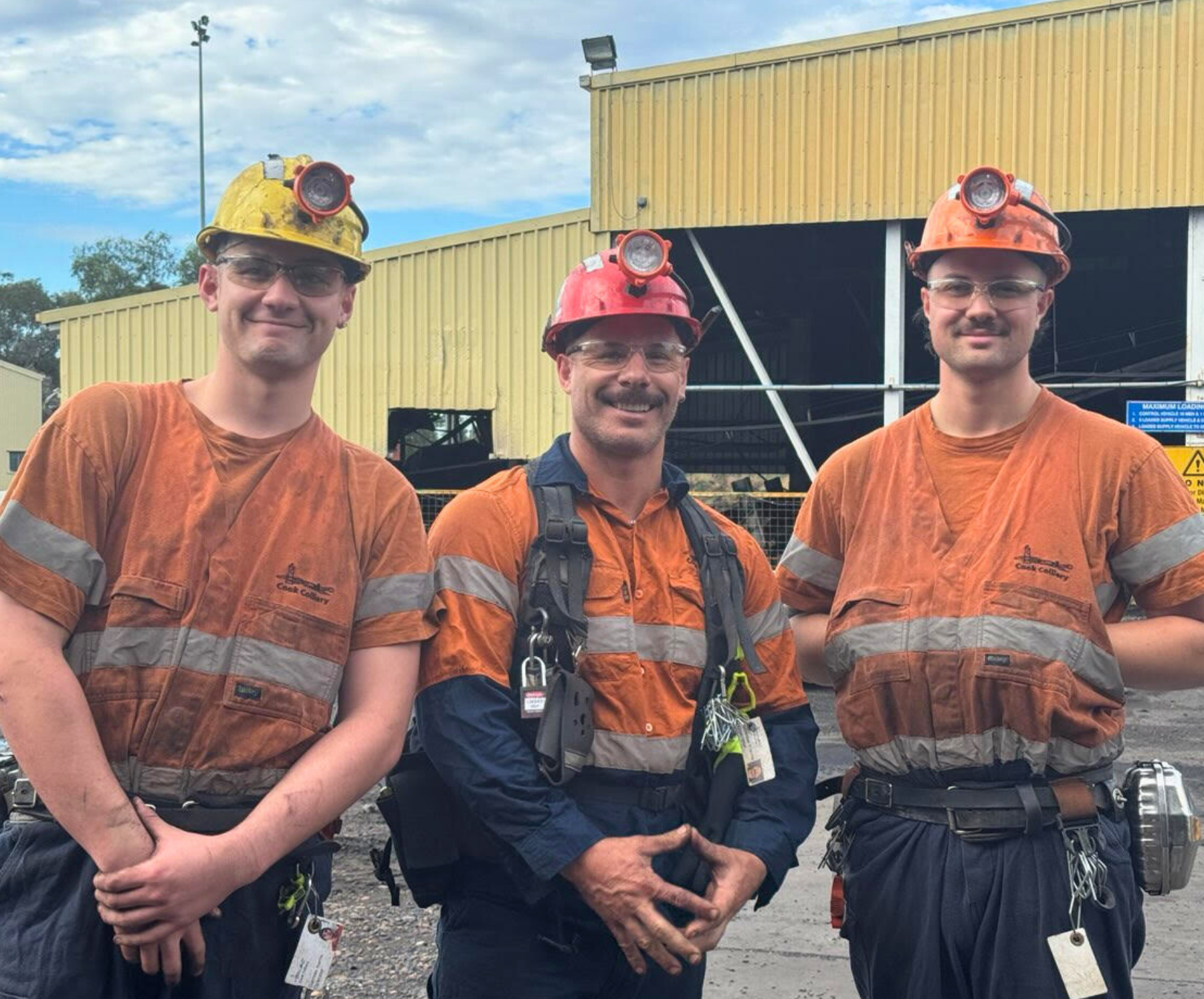
What is FIFO and how does it work?
FIFO stands for fly-in, fly-out. Most mining jobs in Australia are based at remote mine sites — the Bowen Basin in Queensland, the Pilbara and Goldfields in Western Australia, the Hunter Valley in New South Wales, and various locations across South Australia and the Northern Territory. Rather than living near the mine permanently, FIFO workers fly in from a major city, work their roster on site, and fly home for their break.
On site, you'll live in a mining camp or accommodation village. Meals, accommodation, and flights are covered by the employer. A typical roster might be:
2 weeks on, 1 week off (2:1) — the most common roster for entry-level roles
Even time (1:1 or 2:2) — two weeks on, two weeks off. Highly sought after
8 days on, 6 days off (8:6) — common for some operators
FIFO isn't for everyone. Being away from home for two weeks at a stretch is tough, especially if you've got a young family. But for a lot of people, especially those without commitments tying them to a specific location, it's a lifestyle that works well and pays extremely well.
Some mining jobs are DIDO (drive-in, drive-out) if the mine is within driving distance of a regional town. And a smaller number of roles are residential, meaning you live in the nearby town permanently.
How do I actually get hired?
Having the right tickets gets your application through the door. Getting hired comes down to how you present yourself and where you look. Here's what works:
Get your induction done first. Don't wait until you see a job ad and then scramble to get your tickets. Have your mine induction and medical done before you start applying. Employers want people who are ready to start, not people who need two weeks to sort their paperwork. If you're planning to work in Queensland, that means getting your Standard 11. If you're targeting WA, get your General Induction.
Register with mining recruitment agencies. Most entry-level mining jobs are filled through labour hire and recruitment agencies rather than direct applications. The big ones to register with include:
WorkPac
Chandler Macleod
Hays
Programmed
BHP Careers (direct)
Glencore Careers (direct)
Rio Tinto Careers (direct)
Fortescue Careers (direct)
Create profiles on SEEK, Indeed, and Jora with "mining" and "no experience" in your search filters. Set up job alerts so you're notified the moment new roles are posted.
Tailor your resume for mining. You don't need mining experience, but you do need to show that your existing skills are relevant. Highlight anything involving physical labour, shift work, safety compliance, working in remote locations, operating machinery, or working in a team environment. If you've worked in construction, transport, farming, manufacturing, or the military, you've already got transferable skills that mining employers value.
Be upfront about having no experience. Don't try to hide it or pad your resume. Employers hiring for entry-level roles know they're getting beginners. What they want to see is the right attitude: reliable, safety-conscious, willing to learn, and physically fit. Your cover letter should say exactly that.
Be flexible on location and roster. The more flexible you are, the more options you have. If you're only willing to work one specific roster at one specific mine, you'll be waiting a long time. Cast a wide net, get your foot in the door, and you can be more selective once you've got experience on your resume.
Consider a traineeship. Several major mining companies run formal traineeship programs for entry-level workers. These are structured pathways that combine on-the-job training with formal qualifications. BHP, Glencore, Rio Tinto, Fortescue, and Anglo American all run traineeships across Australia. They're competitive but they're specifically designed for people with no mining experience.
Where are the mining jobs in Australia?
Australia's mining industry is spread across every state, but the biggest concentrations of jobs are in:
Queensland: The Bowen Basin is home to some of the largest coal mining operations in the world. Towns like Moranbah, Emerald, Blackwater, and Mackay are the hubs. There's also significant mining activity around Mount Isa (copper, zinc, lead) and Weipa (bauxite). Queensland requires a Standard 11 mining induction to work on coal and metalliferous mine sites.
Western Australia: The Pilbara region (iron ore), Goldfields-Esperance (gold, nickel), and the Mid West are where most WA mining jobs are concentrated. Newman, Tom Price, Kalgoorlie, and Karratha are the key towns. WA requires a General Induction (GI) for mine site access.
New South Wales: The Hunter Valley is the centre of NSW Coal mining. There's also mining activity in Broken Hill (Zinc, Lead, Silver) and various locations across regional NSW.
South Australia: Olympic Dam (Copper, Uranium, Gold) and emerging operations in the Eyre Peninsula and Flinders Ranges.
Northern Territory: Gold, manganese, and bauxite operations, mainly around Pine Creek, Groote Eylandt, and Gove.
What about the lifestyle?
Be realistic about what you're signing up for. Mining pays well because the work is demanding:
12-hour shifts are standard — usually either 6am to 6pm (day shift) or 6pm to 6am (night shift).
The work is physical. Depending on the role, you'll be on your feet all day, working in heat, dust, and noise.
You'll be away from home. FIFO rosters mean two or more weeks away at a time. That's hard on relationships, family life, and social commitments.
It's remote. Mine sites are in the middle of nowhere. The camp has a gym, a mess hall, and maybe a pool, but that's about it. Bring books, a good pair of headphones, and the right mindset.
Drug and alcohol testing is strict. Random testing is standard on every mine site. Zero tolerance.
On the flip side, the money is excellent, the breaks are long (a full week or two off at a time), and the camaraderie on site is great. A lot of people who try mining for six months end up making a career of it.
What’s the first step?
Get your mining induction. Everything else flows from there. It's the one qualification that every mining job requires in some form, and you can complete it online in a few days without leaving home.
If you're looking to work in Queensland, the Standard 11 Surface mining induction is where you start. Core Crew Training (RTO 45671) delivers it 100% online — complete your course from anywhere in Australia, at your own pace, and get your Statement of Attainment issued the same day you finish. Full course $600, refresher $400, with Klarna available for payment in 4 installments.
Not sure which induction you need? Get in touch with our team and we'll point you in the right direction.
